


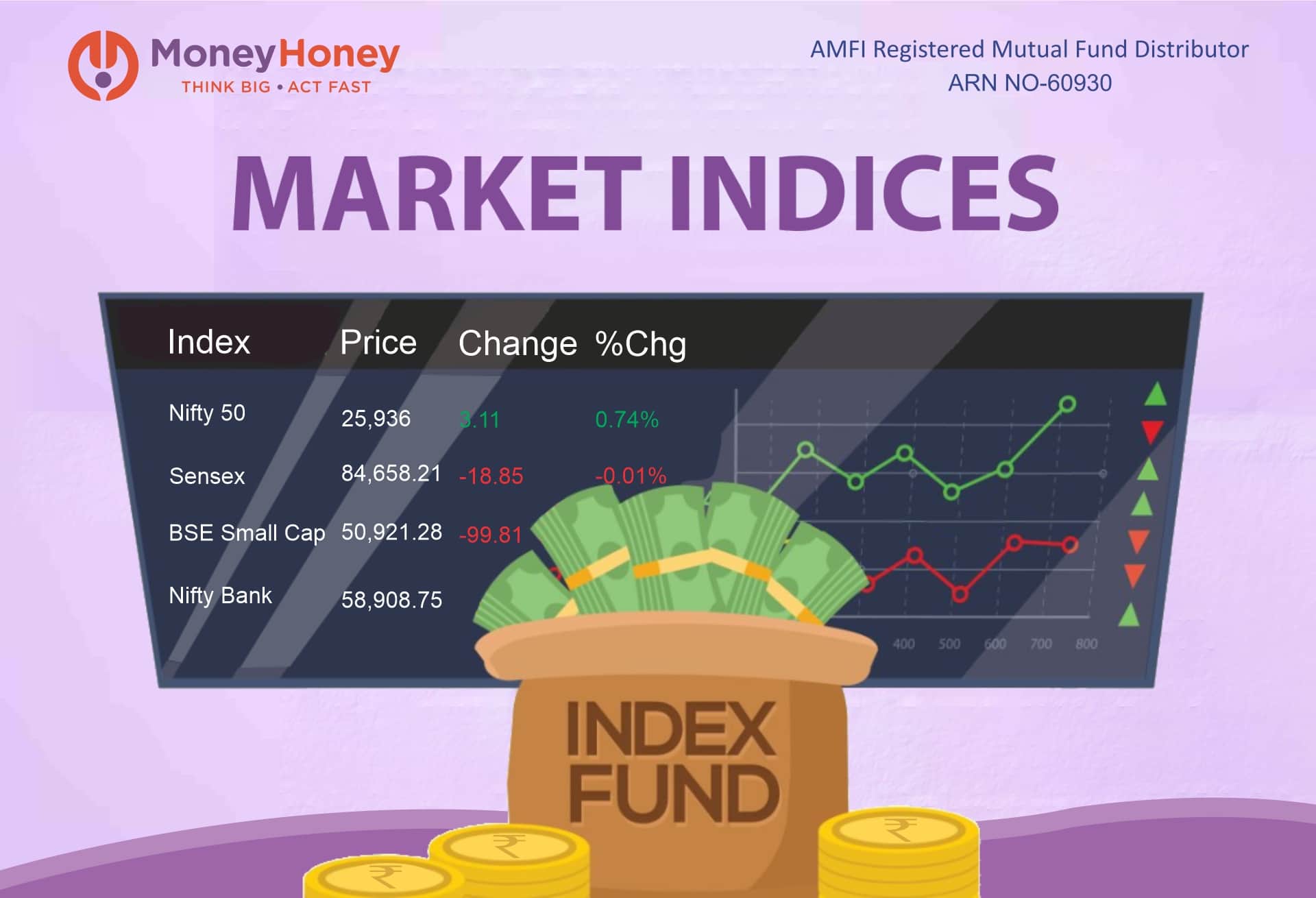
What is an Index?
An index is a measurement tool that is used to monitor the overall performance of a particular set of items. In India, Nifty 50 and BSE Sensex are the two primary benchmark market indices (plural of index) that monitors the overall performance of the Indian stock market.It gives a straightforward, single figure that indicates the general performance of overall market or of a particular segment of the market.
What is index Mutual fund?
An index fund is a specific category of mutual fund designed to replicate the performance of a particular market index.It is an investment option that follows a passive strategy, aiming to replicate the performance of a specific stock market index, such as the Nifty 50 or BSE Sensex called as “benchmark” here. This investment tool is becoming increasingly popular in India as it lets one mirror the market performance without the stress of trying to beat it.
Here, the fund Manager does not play an active role in selecting industries and stocks to build the portfolio but simply invests in all the stocks that make up the index to be followed. The weightage of the stocks in the fund closely matches the weightage of each of the stock in the index.
Index Mutual Fund Investments:
An Index Mutual Fund invests in stocks that replicates a stock market index like the Nifty 50 or Sensex.Investing in index mutual funds is one of the most cost-effective, low-hassle ways for individuals to build wealth over the long term and invest in the stock market.
Ideally one should stay invested in equity index mutual funds for a minimum investment period of 7 years or more. This extended timeframe allows investments to ‘average out volatility’; while short-term market fluctuations may still result in negative returns.
Index vs Active Mutual Funds:
| Index Mutual Fund | Active Mutual Fund | |
| Goal | Aims to match or replicate the performance of a specific index. | Aims to outperformits benchmark after all expenses. |
| Fees | Lower fees as fund manager does not use his skillto include the stocks, only passively follows the index. | Fees are relatively higher than passive funds as fund manager is actively involved in selecting the stocks. |
| Returns | Yields similar returns as of the benchmark. | Potential to generate alpha as it actively plays with the stocks to outperform its benchmark. |
| Diversification | Index funds offers instant diversification across various sectors, reducing the risk. | Here, it involves active selection of stocks which may lead to concentration risk. |
| Risk | These funds require minimal human intervention, reducing the risk of human error. | Comparatively higher risk than index funds as it may involve risk of human error. |
Types of Index Funds in India:
- Broad-Market Index Funds - Provides exposure to the overall economy. For example, the SBI Nifty Index Fund closely tracks the Nifty 50 Index, which comprises India's top 50 company’s stocks across different sectors.
- International Index Funds - These funds replicate foreign market indices, allowing Indian investors to have exposure to global markets. For Example - Motilal Oswal S&P 500 Index Fund seeks investment return that corresponds to the performance of S&P 500 Index.
- Sector-Based Index Funds - Provides exposure to a targeted sector's potential growth.These funds provide exposure to specific sectors, such as healthcare, IT, banking, etc. For example - Tata Nifty Auto Index Fund has Nifty Auto TRI as its benchmark which tracks the companies of Indian automobile sector.
- Factor-Based or Smart Beta Index funds - These funds use specific factors such as value, growth, or low volatility to optimize returns or manage risk. For example, UTI Nifty 200 Momentum 30 Index fund tracks Nifty 200 Momentum 30 Index which invests in 30 high momentum stocks from Nifty 200 index.
- Debt Index Funds - These funds follow fixed-income indices that offer exposure to bonds and other debt securities. For example - Bandhan CRISIL IBX Gilt June 2027 Index Fund.
- Market Capitalization Index Funds - Focuses on company size (Current stock price*No. of outstanding shares).
These funds allowinvestors to access large, mid, or small-cap segments of the companies. For example, the ICICI Prudential Nifty Midcap 150 Index Fund aims to mirror the performance of the NIFTY Midcap 150 Index, providing an opportunity to invest in companies with medium market capitalization (companies ranked 101-250 from Nifty 500). - Equal Weight Index Funds - These funds allocate an equal weight to all index components ensuring that all the companies in the portfolio have equal weight and no single stock dominates the portfolio. For example, ABSL Nifty 50 Equal Weight Index Fund.
- Thematic Index Funds - These funds focus on specific investment themes. Here, market exposure is according to the chosen theme to make the most of prevalent market trends. For Example, thematic funds may include infrastructure, ESG (Environmental, Social, and Governance), travel and tourism related and more.
How to Invest in Index Mutual Funds?
Investing in mutual funds can seem complicated, but it is one of the simplest and most powerful ways to build wealth. Here's the process-
- Determine your financial goal and risk level:
Decide what is your purpose of investing and how much you can bear risk. - Complete KYC process:
It’s an identification process for first time investors. It can be done online and offline. For online, you can get it from website of the respective fund house or RTA (Registrar and Transfer Agents). For offline process, download KYC form and submit it to nearest fund house office or can take help of any mutual fund distributor like Money Honey Financial Services Pvt Ltd for the same. - Choose right investment platform:
You can choose to invest directly via AMC, if you have good financial knowledge or choose to invest via a mutual fund distributor. - Choose right investment method:
SIP or Lump-sum? Lump-sum is suitable when you have extra funds to invest at once whereas SIP gives you the flexibility to invest a small fixed amount at fixed interval of time. - Select correct mutual fund to invest in:
Explore different index funds available in the market. Depending on your financial objectives, choose the fund that you want to invest in. - Place Investment Order.
Use Expert Guidance:
Making a financial plan can guide you through your goals and construct an investment plan suitable to achieve those goals. Thus, in 2026 if you want to build a well-balanced portfolio and spread risk across various sectors, size; you can invest in index funds. They provide an efficient way to gain exposure to entire markets.
Reliable AMFI registered mutual fund distributor like Money Honey Financial Services Pvt. Ltd. can help you decide to pick an index mutual fundthat suits to your needs and risk profile.
Disclaimer: This report is prepared in his personal capacity and neither the Author nor Money Honey Financial Services Pvt Ltd assumes any responsibility or liability for any error or omission in the content of the article. Investments in mutual funds and other risky assets are subject to market risks. Please seek advice from an investment professional before investing.