


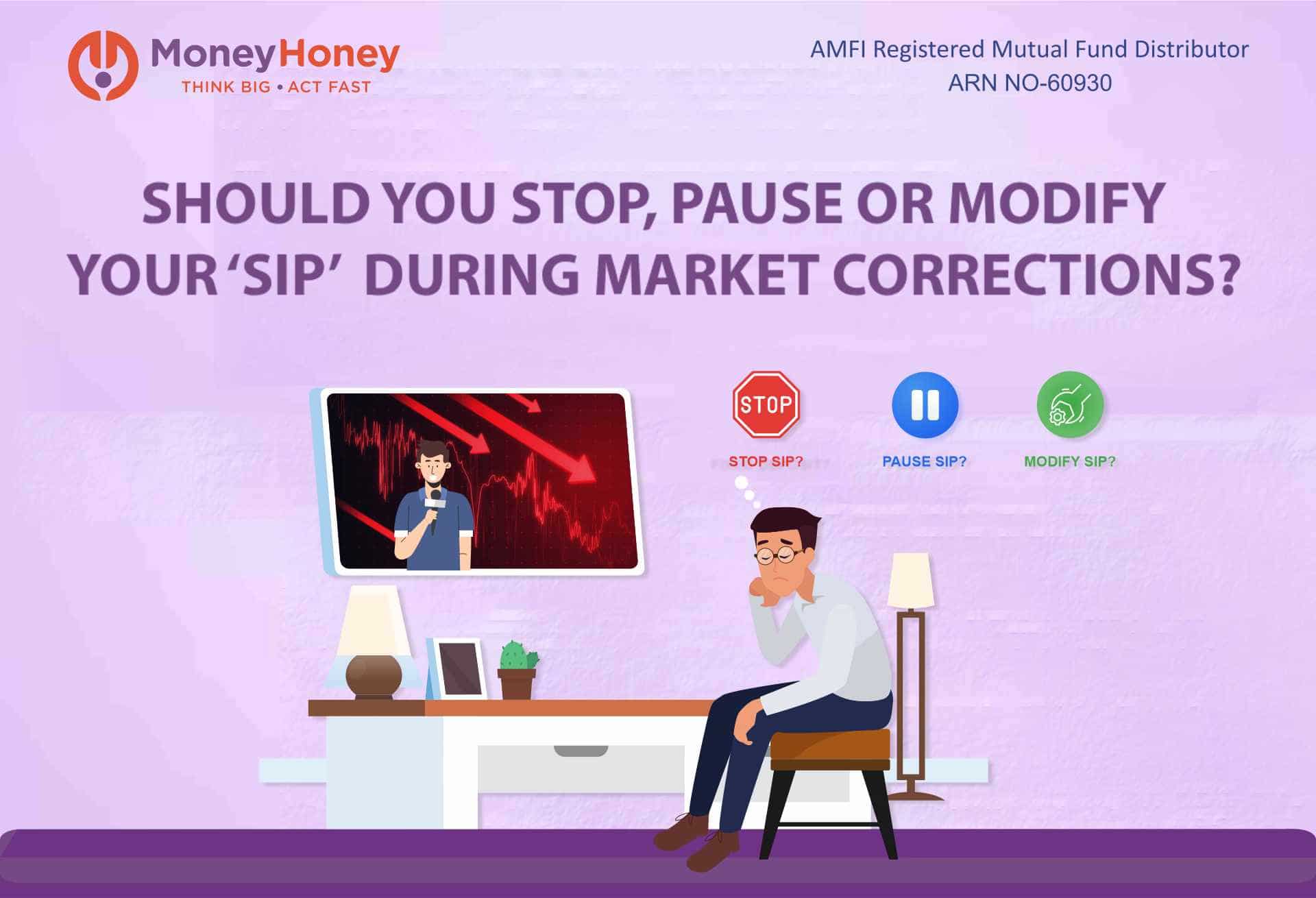
Market corrections are an unavoidable part of investing. Whenever equity markets fall sharply, investors often feel anxious. For SIP (Systematic Investment Plan) investors, this anxiety usually leads to one big question to continue investing or not.
In this blog, we’ll explain market corrections, how SIPs work during downturns, and what smart investors should ideally do.
What Is a Market Correction?
There’s one phrase that often makes investors uneasy- ‘market correction’. It generally refers to a price fall of 10% to 20% from recent market highs.However, corrections are most of the times normal, healthy, and recurring features of equity markets, they occur due to various reasons such as:
- Global economic concerns
- Interest rate changes
- Inflation worries
- Geopolitical tensions
While corrections may feel uncomfortable, but history shows that markets have always recovered over time and ‘SIP’is built specifically to manage such market volatility.
How SIPs Are Designed to Handle Market Corrections?
Negative headlines may sound alarming, however corrections are not the same as market crash. This emotional pressure of seeing falling markets often pushes SIP investors in thinking; whether to stop or pause their SIPs? However, it’s important tounderstand that market corrections are temporary phases within long-term growth cycles and SIPs works best in such situations. Features of SIP are as follows-
- Rupee cost averaging-
SIPs allow investors to invest a fixed amount at periodic intervals, so units are purchased at different times at different NAV, which helps to average out the cost per unit in mutual funds. This strategy called rupee-cost averaging is particularly effective during market corrections as it enables the purchase of more units when prices are low. So, when the market eventually recovers, it can boost returns significantly.
- Consistent investing-
SIPs remove the need to time the market by investing regularly; you participate in both ups and downs, which smoothens returns over the long term. Thus, by remaining consistent in investing, investors can smooth out the market cycles.
- Compounding benefit-
Benefit of compounding is dependent upon uninterrupted investing to be effective. A broken cycle in investment period might weaken the compounding effect on investments which may lead to diminished returns.
Reasons to Not Stop or Pause SIP:
Decision to stop or pause SIP can seem tempting during market corrections. However, this choice may come with risks such as-
- It misses the opportunity to buy the units at low price as it goes against the core philosophy of SIP’s - ‘rupee cost averaging’.
- You might disrupt your long-term strategy by breaking both the consistency and momentum of your overall investment approach.
- It can disrupt compounding benefits, reduce unit accumulation, and increases the risk to re-enter the market at higher price later.
In fact, one may think to modify their SIP by increasing its amount in such times, so that more units can be accumulated and long-term goals can be achieved faster. By not interrupting your SIP or by increasing it - you ensure that your money is invested during the market's recovery phase, where you might generate high returns.
Thus, rupee-cost averaging and disciplined and consistentinvesting - these two features of SIP make them work effectively during market corrections.In simple terms, market corrections might actually improve SIP effectiveness and create opportunities for better returns, provided you stay invested.
How to Optimise Your Investments During a Market Correction?
- Ignore the noise and stay invested as markets may recover overtime.
- Continue or Increase SIP so that you can accumulate more units at low price.
- Seek expert guidance for appropriate decision.
Things to Remember:
- Most of the times market corrections are normal and temporary.
- Avoid frequent monitoring of returns as it increases anxiety and leads to impulsive decisions.
- Emotional decisions to stop or pause SIP would mean missing out on future gains.
- Selling investments during corrections might lock in losses, removes recovery potential and harms long term goals.
- Reacting to news channels and social media may amplify fear during corrections.
Conclusion:
Market corrections test investor’s patience, but staying invested may offervaluable opportunities for long-term investors. SIPs are designed to work with market volatility and not against it. They work because they remove the guesswork of timing the market. Staying invested during corrections may feel uncomfortable in the moment, but history shows that discipline and patience has been often rewarded.
That said, also remember past performance is not indicative of future returns, and markets remain subject to fluctuations. Thus, seeking investment advice from professionals like mutual fund distributor during such times is recommended.
Disclaimer: This report is prepared in his personal capacity and neither the Author nor Money Honey Financial Services Pvt Ltd assumes any responsibility or liability for any error or omission in the content of the article. Investments in mutual funds and other risky assets are subject to market risks. Please seek advice from an investment professional before investing.